

Key Takeaways
- Choose a supplement bottle based on the finished capsule size and the actual count per bottle.
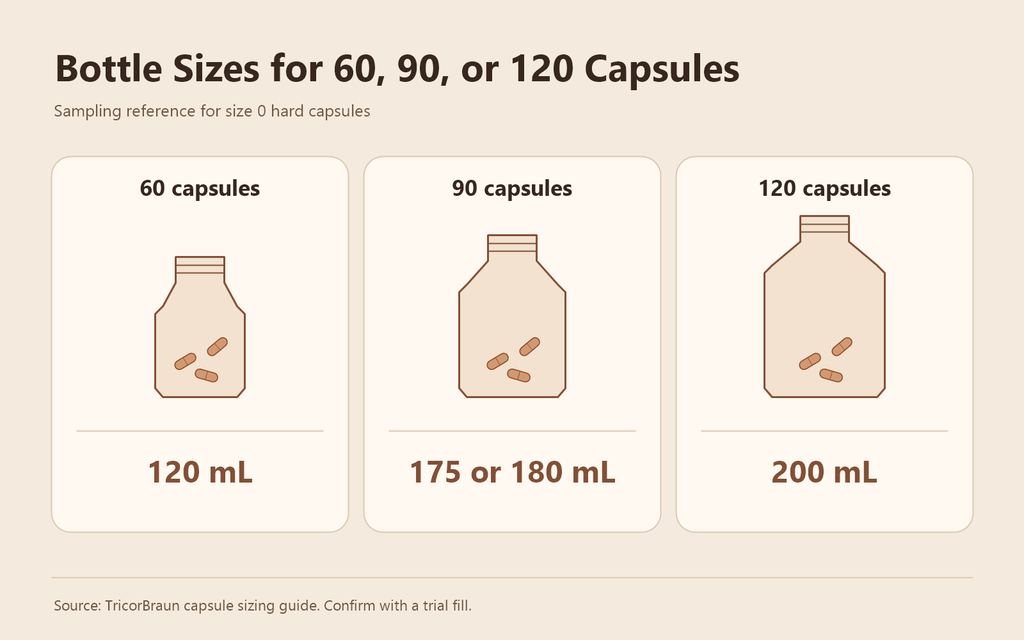
- For size 0 hard capsules, start by sampling 120 mL for 60 capsules, 175 or 180 mL for 90, and 200 mL for 120.
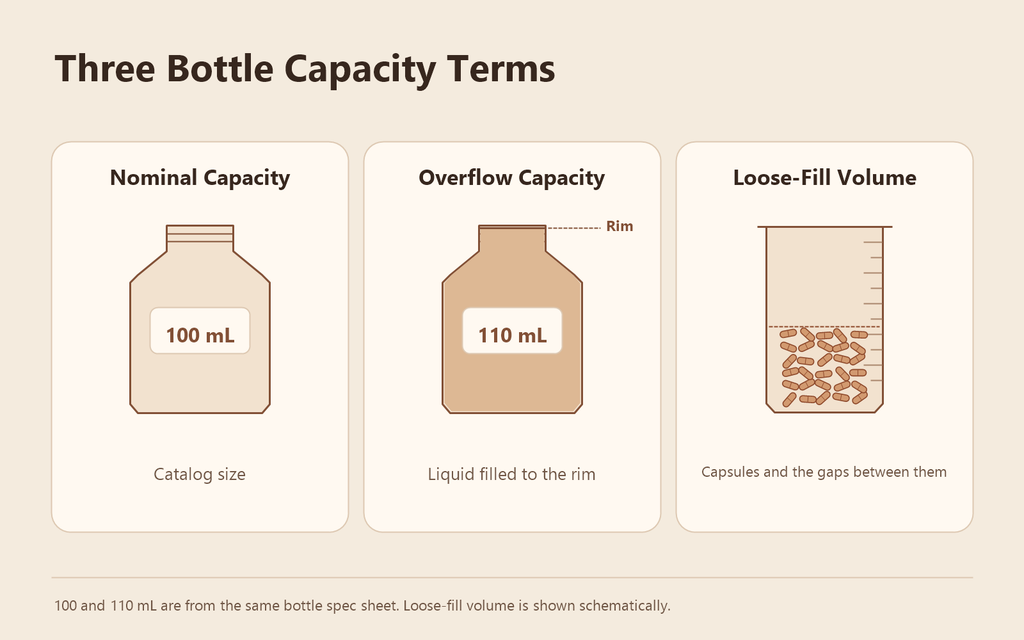
- Compare nominal capacity and overflow capacity on the spec sheet. Measure loose-fill volume with your actual capsules.
- Trial-fill each candidate with the intended capsules and desiccant, if used. Check the rim for trapped capsules, confirm the cap seats fully, and test dispensing.
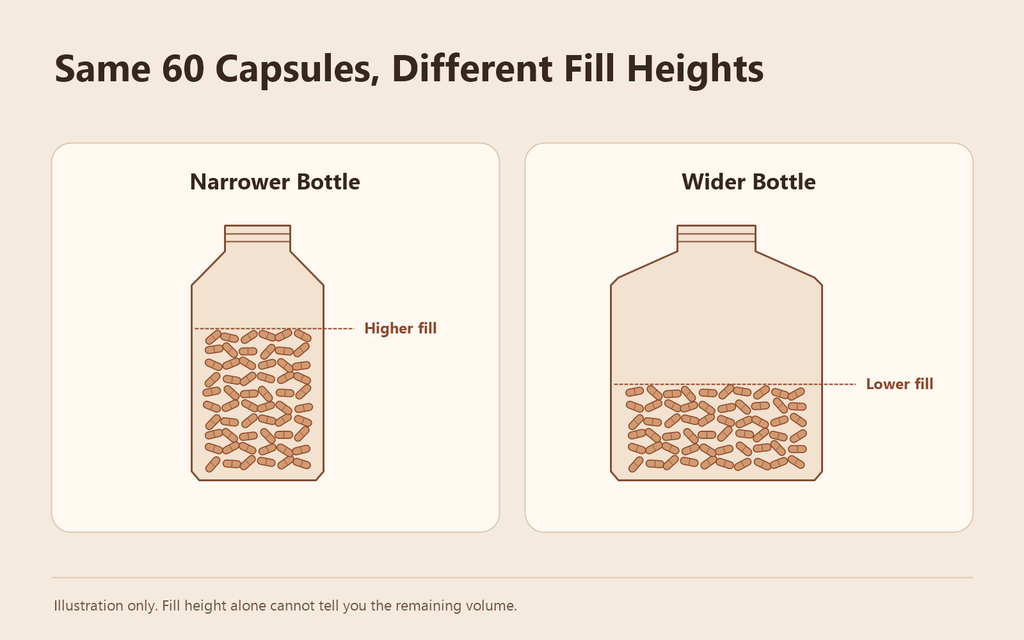
- If a bottle looks half empty, verify the count first. Bottle shape and settling can change the visible fill height.
When you first source supplement packaging, the supplier will usually ask for the dimensions of the finished capsule and the number of capsules per bottle. For a 60-count pack, TricorBraun’s guide lists 120 mL for size 0 hard capsules and 180 mL for size 00 hard capsules. If you plan to use a desiccant, include it in the trial fill. Use the sizing guide to shortlist bottles, then check whether your actual capsules go in easily, the cap seats properly, and the last few capsules are easy to dispense.
Confirm Capsule Dimensions and Count Before Requesting Samples
If a contract manufacturer makes your capsules, ask for the full size designation, finished length, maximum outside diameter, and a physical sample. Numbers such as 0, 00, and 1 in a capsule size chart refer to capsule sizes. Some sizes have extended-length versions. Include the full designation and the outside dimensions of the closed capsule in your sample request. If you have only the formulation weight, ask the manufacturer for the finished capsule dimensions.
| Information to send | What to include |
| Capsule specifications | State whether the product is a hard capsule or a softgel. Include the full size designation, length, and maximum outside diameter. Send a finished sample when available. |
| Count per bottle | State the actual capsule count. Two capsules per serving and 45 servings per bottle means 90 capsules per bottle. List each count separately if you offer several pack sizes. |
| Items packed inside | If you have selected a desiccant, give its dimensions and quantity per bottle and state whether it goes in before or after filling. |
| Packaging process | Tell the supplier about any counting equipment, cap, or sealing method the filling facility has already specified. |
Ask whether bottle samples come with matching caps and seal liners. Empty bottles are useful for comparing fit and fill height. To check cap fit, use the intended cap with the liner installed if that is how it will be supplied.
Use a Sizing Guide to Shortlist Capsule Bottles
To choose a supplement bottle from a sizing guide, match the finished capsule size and the actual count per bottle. TricorBraun’s chart uses cubic centimeters (cc), which are numerically equivalent to milliliters (mL). The table gives starting sizes for sampling size 0 hard capsules. Select new samples if you switch to size 00, an extended-length capsule, or a different shape.
| Capsules per bottle | Reference capacity for size 0 capsules | What to check on the sample |
| 60 | 120 mL | See whether the pile reaches the shoulder, where the bottle narrows toward the neck. Try pouring from a full and a nearly empty bottle. Watch for capsules coming out in a rush or getting caught at the shoulder. |
| 90 | 175 or 180 mL | Request one sample of each with its part number. Compare the bottle width, shoulder shape, and minimum neck inside diameter. Pour in 90 capsules using the same method for both. |
| 120 | 200 mL | Include the intended desiccant, if used. Check the rim for trapped product and confirm that the matching cap starts straight and seats properly. |
Sample Request for a 90 Count Pack
If the supplier stocks 175 mL and 180 mL bottles, ask for each bottle’s part number, dimensional drawing, and matching cap. The part number ties the sample to the quote and purchase order. The drawings let you compare the opening and shoulder.
We plan to pack 90 size 0 hard capsules per bottle. The finished capsule dimensions are attached. Please send 175 mL and 180 mL samples with the part number and drawing for each. Include the nominal capacity, overflow capacity, minimum neck inside diameter, and matching caps. If you recommend a seal liner, please include its part number.
If the filling chute needs to enter the neck, send both drawings to the filling facility so it can verify clearance. Label each sample with its part number and use capsules from the same batch at the same count. Record whether you need to shake the bottle or move capsules by hand before the cap can seat.
Understand the Three Capacity Terms
Supplier catalogs often list bottles for capsules and tablets under packer bottles. Start with the bottle part number, nominal capacity, overflow capacity, and neck finish.
One round HDPE packer bottle, part number 12-0399, has a nominal capacity of 100 mL, an overflow capacity of 110 mL, and a 38-400 neck finish. Use the part number to identify the bottle, the capacity figures to compare candidates, and the neck finish to find matching caps. Confirm capsule fit with the finished product.
Nominal Capacity for Finding and Ordering Samples
Nominal capacity is the size used to identify the bottle in a catalog. If two suppliers quote 100 mL, confirm which capacity field they use, then compare the drawings and part numbers. A tall bottle and a wide bottle can have the same nominal capacity and give different fill heights. Record the supplier, part number, and drawing revision for the sample you approve.
Overflow Capacity and Usable Space
Overflow capacity is the volume of liquid the bottle holds when filled to the rim. In the example above, the 10 mL difference between 110 mL and 100 mL comes from two specifications for the empty bottle. The space left after filling depends on how the capsules settle, the shoulder profile, and any items packed inside. Trial-fill the bottle with the intended count and desiccant, if used. Check the rim for trapped product and confirm that the matching cap seats properly.
Loose Fill Volume for Screening Candidate Bottles
Loose-fill volume is the approximate volume occupied by a pile of capsules poured naturally into a graduated container, including the gaps between them. A capsule size chart may also list the internal volume of a single capsule, which describes how much material fits inside it. Multiplying that value by the capsule count gives the total internal volume of the capsules. Measure the finished capsules as a group to estimate their space requirements, then check how the bottle’s shoulder and opening affect the trial fill.
On the neck drawing, look for the minimum inside diameter, often marked I. A finish code such as 38-400 helps identify compatible caps. To check whether the capsules or filling chute can pass through, use the inside diameter and observe whether several capsules poured together catch at the opening.
Trial Fill the Candidate Bottles
Measure the Loose Fill Volume
For a 60-count pack, count out several groups of 60 capsules from the same batch. Put a graduated container on a level surface. Pour each group the same way and read the volume at the same point after pouring. Because the top of the pile is usually uneven, agree on a consistent way to read it and record the range across the measurements.
If capsules wedge against each other and block the opening of the measuring container, use a container with a more suitable opening and repeat the measurement. If you tap the container or let it stand, use the same procedure for each group and note it in the record. Measure 90- and 120-count groups separately if you are developing those packs as well.
Check Filling Capping and Dispensing
Give each capsule bottle a sample ID and record its part number and nominal capacity. Use capsules from the same batch, of the same size, and at the same count. If the project uses a desiccant, add it in the intended production sequence. Inspect the capsules after pouring, then fit the cap and test dispensing.
| Check | How to check | What to record |
| Shoulder | Stand the bottle upright and view the top of the pile from the side. | Whether the pile reaches the narrowing shoulder and whether any capsules catch there. |
| Sealing rim | Before capping, look down at the opening and the rim. | Any capsule across the opening or debris on the surface that meets the seal. |
| Desiccant and cap fit | Add the specified desiccant if needed, then fit the matching cap. | Whether the cap starts straight and seats fully. Note any shaking or repositioning of the desiccant. |
| Dispensing | Try pouring a set number of capsules from full, half-full, and nearly empty bottles. | Whether too many come out, whether you have to shake the bottle, and where the last few catch. |
Stand the candidates on the same level surface and photograph them from the same angle. Include each sample ID and capsule count in the photo. When you send the photos to the supplier or filling facility, include the part numbers and observations.
Why a Supplement Bottle Can Look Half Empty
Verify the Actual Count
Take an unopened finished sample and record the bottle part number, batch, and labeled count. Empty the capsules onto a clean tray and count them in groups. Check the shoulder, base, and area around any desiccant for capsules that stayed behind. If the count differs from the label, retain the sample and ask the filling facility to check the batch records.
Compare Fill Height Across Bottle Shapes
Use the same capsule batch, size, count, and pouring method for each candidate. If you use a desiccant, add the same type in the same sequence. Stand the bottles upright on a level surface and take side photos from the same height. For an opaque bottle, take an additional photo through the opening to show the pile relative to the shoulder.
With other conditions similar, capsules can spread across a wider bottle and form a lower pile. The cross section also changes where the shoulder tapers. A pile halfway up the bottle shows the visible fill height. Estimating the remaining volume in milliliters requires more information about the bottle’s internal shape.
Check for Settling After Handling
Verify the count, close the bottle, and photograph it on a level surface. Handle it in an agreed way and record whether it was boxed and in which orientation. Put the same bottle back in the original position, take a second photo from the same angle, and recount the capsules. If the count matches and the pile is lower, keep both photos and the handling details as a record of the change observed in that sample.
Check Whether the Headspace Serves a Purpose
A smaller bottle may hold the target count, but the corner of a desiccant packet may catch at the neck and need to be moved by hand before capping. If a second bottle lets you insert the packet and fit the cap under the same conditions, record that difference. If both bottles pass the filling, capping, and dispensing checks, compare their appearance, bottles per shipping carton, and shipping performance.
Record the Approved Bottle in the Purchase Specification
Once a bottle passes the trial fill, give the physical sample an ID. Record the approved bottle, cap, and seal liner in one purchase specification and retain the sample with the trial record. Keep a separate record for each 60-, 90-, and 120-count pack, even if two counts use the same bottle part number.
| Specification field | What to record |
| Capsules and count | Full finished capsule size designation, length, maximum outside diameter, and actual count per bottle. |
| Bottle | Supplier, part number, material, color, and drawing revision. List nominal and overflow capacity separately. Reference the neck finish and minimum inside diameter on the drawing. |
| Cap and seal liner | Separate part numbers for the cap and liner. Specify if the supplier is to deliver the liner preinstalled. |
| Items packed inside | If you use a desiccant, record its part number or specifications, the quantity per bottle, and the insertion sequence used in the trial. |
| Sample approval | Sample ID, approval date, photos, and the results of filling, cap fit, and dispensing checks. |
Record the capsule batch, actual count, specified desiccant if used, and matching cap. If the trial was done by hand, label it hand trial fill. If the check covered only whether the cap seated properly, record cap fit passed so the next buyer knows exactly what the sample demonstrated.
Use the same part numbers in the order and the approved sample record. The following wording can go in a purchase order or specification attachment.
Pack count ____ capsules per bottle. Finished capsule size ____. Bottle supplier part number ____ and drawing revision ____. Material and color ____. Nominal capacity ____ mL. Overflow capacity ____ mL. Matching cap part number ____. Seal liner part number and delivery configuration ____. Items packed inside ____. Approved sample ID ____. See trial record ____ for filling, cap fit, and dispensing results.
On receipt of the first shipment, check the bottle, cap, and liner part numbers against the carton labels or packing list, then compare samples with the approved pack. If a supplier proposes a different bottle with the same listed capacity, compare the new drawing and sample and recheck the shoulder, opening clearance, and cap fit. If the capsule dimensions or desiccant change, repeat the trial fill and check for trapped product at the rim, proper cap fit, and easy dispensing of the last few capsules.
Frequently Asked Questions
Should I start with a stock supplement bottle or invest in a custom mold?
A stock bottle with a custom label is a practical starting point for a first launch. Ask about available colors and whether the same bottle can be reordered after launch. If your design requires a distinctive shape or molded logo, request a custom quote that separates tooling costs from production costs and specifies who owns the mold.
Should I use glass or plastic supplement bottles for online orders?
Compare the packed shipment, including the filled bottle, carton, dividers, and cushioning. Glass can add weight and may require more protection against breakage. Pack and weigh each option as it would ship to a customer, then compare the shipping cost and inspect the bottles after a trial shipment.
When should I order printed supplement bottle labels?
Order production labels after you have the bottle sample and the supplier’s drawing for the usable label panel. Print a paper proof at actual size and wrap it around the sample. Check where the seam falls, whether the text stays clear of the shoulder and base curves, and whether the barcode fits on a suitable part of the label. Then test a sample printed on the intended label material before committing to the full run.
Can I use the same barcode for my 60-count and 90-count bottles?
Assign each retail pack its own GTIN, the product identifier encoded in the barcode. Under GS1 rules, a change to the declared count requires a different GTIN. Create the two product records before sending the labels to print, then check that each barcode matches the count shown on its label.
What’s the difference between a tamper-evident seal and a child-resistant cap?
A tamper-evident seal gives the customer a visible sign that the package may have been opened. Child-resistant packaging is designed to make the package difficult for young children to open. If your product requires child-resistant packaging, ask for test documentation that covers the specific bottle-and-cap combination you plan to buy.
Why do bottles, caps, and labels have different minimum order quantities?
Suppliers may sell bottles by the case or pallet, while caps, liners, and printed labels can each have a separate minimum. Ask for a quote that shows the minimum quantity, unit price, and lead time for each component. Then check how many complete packs you can make and what happens to any leftovers. For example, if you order 2,000 bottles and the printer requires 3,000 labels, confirm who will store the extra labels and whether you can use them on the next run.